ProAlanase (Mass Spec Grade)
New Site-Specific Endoprotease that Targets Proline and Alanine
- Cleaves primarily C-terminal to proline and alanine residues
- Active at acidic pH (1–5.5) with a pH optimum of ~1.5
- Short digestion times of 1–2 hours

Catalog Number:
Size
Catalog Number: VA2161
Catalog Number: VA2171
ProAlanase, the Newest Alternative to Trypsin for Proteomic Research
ProAlanase is an endoprotease that preferentially cleaves proteins on the C-terminal side of proline and, to a lesser extent, alanine amino acids. Isolated and purified from the fungus Aspergillus niger, ProAlanase is also known as An-PEP or EndoPro. Peptides derived from protein digestion with ProAlanase are suitable for identification and characterization by mass spectrometry.
Digestion with trypsin often provides incomplete sequence coverage or missed identification of post-translational modifications. Like Trypsin, alternative proteases such as Lys-C, Asp-N, Glu-C and Arg-C also cleave at charged residues, introducing bias to regions within proteins that are digested. The newest solution is ProAlanase, which cleaves at unique, non-charged sites in the proteome.
See more data on the application of ProAlanase for characterizing protein structure, IgG digestion, post-translational modifications and disulfide bond mapping in the poster “Characterization of Therapeutic Antibodies with a Protease that Cleaves after Proline & Alanine”.
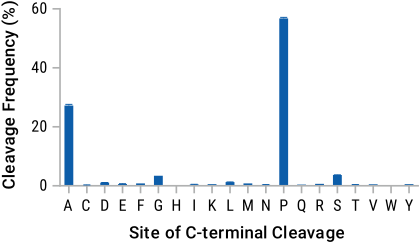
C-terminal cleavage specificity of ProAlanase. Human K562 extract was digested with ProAlanase at pH 1.5 for 2 hours at 37°C using a 1:100 enzyme:substrate ratio. Peptides were analyzed by LC-MS/MS on a Q-Exactive Plus. Data were searched using Byonic™ software with no enzyme specified. Cleavage occurs predominantly on the C-terminal side of proline and alanine.
ProAlanase Featured at US HUPO 2021
Watch the seminar presented at US HUPO 2021 by Dr. Diana Samodova on her collaborative work with Promega using ProAlanase. In the seminar, titled "ProAlanase is an Effective Alternative to Trypsin for Proteomics Applications and Disulfide Bond Mapping", Dr. Samodova discusses her research involving paleoproteomics, histone analysis, de-novo sequencing, and analysis of post-translational modifications (PTMs) including phosphorylation profiling and disulfide bond mapping.

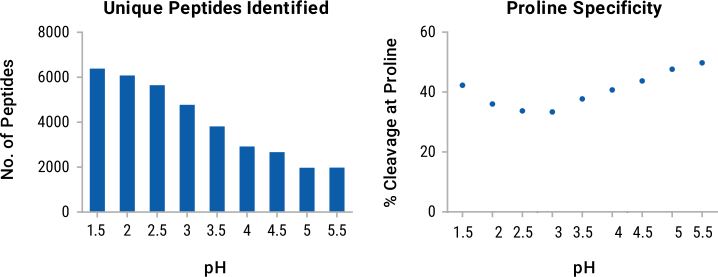
Optimal Digestion at pH 1.5
Optimal performance of ProAlanase is observed at pH 1.5 as determined by the best combination of high peptide identifications and high proline specificity.
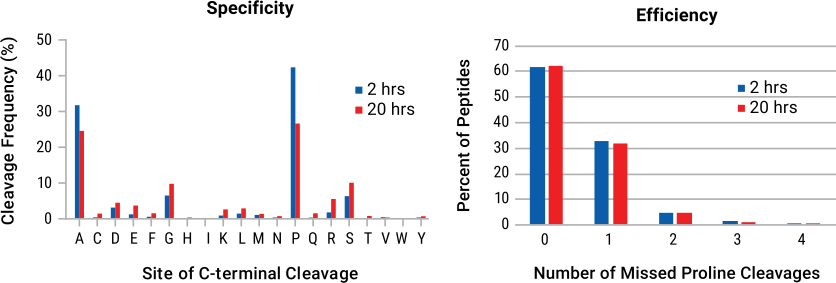
Optimal Performance with Short Protein Digestion Times
Optimal digestion efficiency and specificity of ProAlanase is typically observed with short digests. Longer digestion times can lead to loss of specificity (left) with no obvious gain in digestion efficiency (right).
ProAlanase is Useful for Disulfide Bond Mapping at Low pH
The low pH environment where ProAlanase works best minimizes disulfide bond scrambling and other artificial nonenzymatic post-translational modifications (PTMs) like deamidation.
In addition, the very acidic pH acted as an effective denaturant of NISTmAb IgG and allowed efficient digestion and assignment of all non-hinge disulfide bonds even in the absence of additional denaturants such as guanidine HCl. Digestion using Trypsin under similar non-denaturing conditions at pH 8.0 resulted in poor digestion and assignment of few disulfide bonds.
Reference: Samodova, D. et al. (2020) ProAlanase is an effective alternative to trypsin for proteomics applications and disulfide bond mapping. Mol Cell Proteomics 19(12), 2139–56.
Protocols
Complete Protocol
Specifications
Catalog Number:
What's in the box?
| Item | Part # | Size | Concentration |
|---|---|---|---|
ProAlanase, Mass Spec Grade |
VA216A | 1 × 5μg | 0.2μg/μl |
SDS
Search for SDSCertificate of Analysis
Use Restrictions
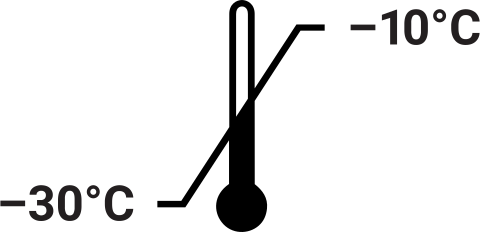
For Research Use Only. Not for Use in Diagnostic Procedures.Storage Conditions
What's in the box?
| Item | Part # | Size | Concentration |
|---|---|---|---|
ProAlanase Plus, Mass Spec Grade |
VA217A | 1 × 15μg | 0.5μg/μl |
SDS
Search for SDSCertificate of Analysis
Use Restrictions
For Research Use Only. Not for Use in Diagnostic Procedures.Storage Conditions
Resources
Related Products
Similar Products
rAsp-N, Mass Spec Grade
Cleavage site: N-terminal of Asp. Optimal pH: 6–9.
VA1160
Arg-C, Sequencing Grade
Cleavage site: C-terminal of Arg. Optimal pH: 7.6–7.9.
V1881
rLys-C, Mass Spec Grade
Cleavage site: C-terminal of Lys. Optimal pH: 8–9.
V1671
Glu-C, Sequencing Grade
Cleavage site: C-terminal of Glu. Optimal pH: 4–9.
V1651